
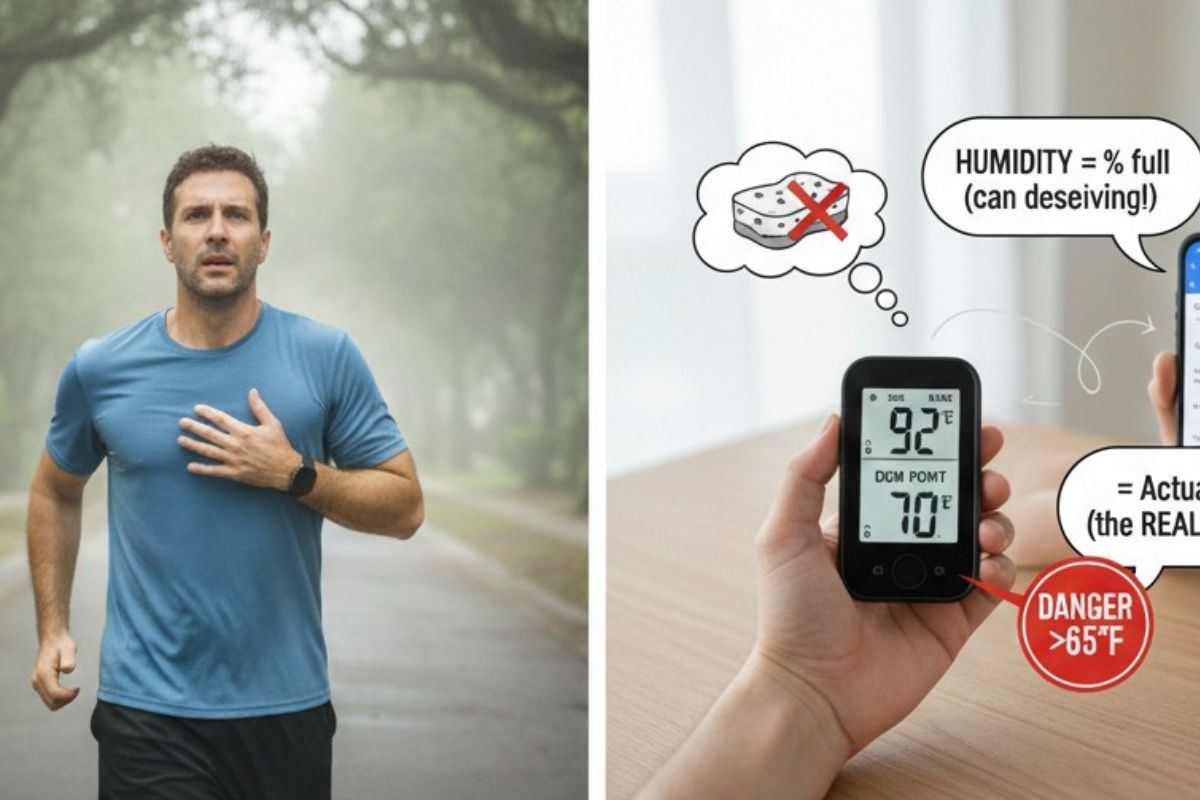
When it comes to dew point vs humidity for breathing, most of us have been looking at the wrong number for years. Have you ever stepped outside on a summer morning and felt like you were walking into a warm, wet blanket? The sky is blue and the sun is out, but your chest feels tight and every breath feels like you’re trying to pull thick soup into your lungs. You aren’t imagining it, and you aren’t out of shape; you are simply experiencing the physical weight of moisture that “relative humidity” fails to explain.
The weather app might say the humidity is only 50%, which sounds like a beautiful day. But as you walk to your car or try to take the dog for a stroll, you realize you’re experiencing the “Relative Humidity Lie.” For those of us who live with shortness of breath, asthma, or COPD, humidity can be a trickster. To truly understand why you can’t breathe, you need to look past the percentage and focus on the absolute measurement of moisture: The Dew Point.

The Day the Air Stood Still (A Story of Two Cities)
Imagine two people. One is in Seattle in the winter. It’s 40°F (4°C) outside, with a humidity level of 90%. The air feels crisp and easy to breathe.
The second person is in Miami in the summer. It’s 90°F (32°C) outside, and the humidity is only 50%. On paper, Miami sounds “drier.” But the person in Miami is gasping for air, while the person in Seattle is perfectly fine.
Why? Because the air in Miami is holding three times more actual water than the air in Seattle.

This is why dew point vs humidity for breathing is the most important topic you can learn if you want to reclaim your energy. Humidity is a percentage—it’s relative. But the dew point is an absolute measurement of how much “water weight” is currently floating in the air around your face.
What Exactly is the Dew Point? (The Sponge Trick)
To understand this without a science degree, think of the air like a sponge.
Air has one main job: it holds onto water vapor. But here is the catch—warm air is a giant, industrial-sized sponge. Cold air is a tiny little makeup sponge.
- Humidity tells you how “full” that sponge is. If a tiny sponge is 90% full, it still doesn’t hold much water. If a giant sponge is only 50% full, it is still holding a massive amount of water.
- Dew Point is the temperature at which that sponge is so full that it can’t hold another drop. If it gets one degree colder, the water “falls out” of the air as dew or rain.
When the dew point is high, the “sponge” of the atmosphere is heavy, soaked, and taking up the space where oxygen should be.
This saturated air doesn’t just feel sticky—it changes the actual physics of every breath you take. Once the ‘atmospheric sponge’ hits its limit, meteorology becomes a medical concern, leading us to a specific threshold every sensitive breather needs to know.
The “Secret” 65°F Rule: Why Your Lungs Panic
While most weather apps emphasize the humidity percentage, the Dew Point is the only metric that truly dictates respiratory comfort. For those living with asthma, COPD, or chronic “Air Hunger,” the number 65°F (18°C) represents a critical biological tipping point. At this precise level, the physics of the air changes, transitioning from merely “sticky” to physically Oppressive.

The Science of the 65°F Tipping Point
Why does 65°F matter? It comes down to Air Density and the displacement of oxygen. Although water vapor is technically lighter than dry air, it occupies significant volume. In a high dew point environment, your lungs must process a higher volume of water molecules to extract the same amount of oxygen.
For a sensitive respiratory system, this triggers two immediate reactions:
- Bronchospasm Risk: The high moisture content irritates the lining of the airways, causing them to narrow (constrict).
- Increased Work of Breathing: Your diaphragm and intercostal muscles must work up to 20% harder to pull “heavy” air into the lungs.
The Human Comfort Scale for Lungs
To manage your health effectively, use this authoritative scale (as shown in the Chatterlane infographic) to monitor daily dew point levels:
- Below 50°F | The Ideal Zone: The air is “light” and dry. This is the gold standard for lung recovery and outdoor exercise.
- 50°F – 60°F | The Comfortable Zone: Standard air quality for most. Standard activities usually do not trigger symptoms.
- 60°F – 65°F | The Muggy/Sticky Zone: The transition begins. You may feel a subtle tightening in the chest or faster fatigue during walks.
- 65°F and Above | The Oppressive Zone: The Red Zone. This is where the risk of severe Air Hunger and Bronchospasm peaks. The air feels like a “wet blanket,” and outdoor exertion should be minimized.
If you are caught in the ‘Oppressive Zone’ and feel the onset of air hunger, you can use the Vagus Nerve ‘Fan Trick’ (explained in detail below) to calm your respiratory panic response instantly.
Why “Heavy Air” Makes Your Lungs Panic
When you have a high dew point, your body has to work twice as hard for two reasons: Oxygen Displacement and Cooling.
1. The Displacement Problem
Oxygen is a gas. Water vapor is also a gas. There is only so much room in a “pocket” of air. When the air is filled with water vapor (high dew point), there is physically less room for oxygen molecules.
When you breathe in “soupy” air, you are literally getting less oxygen per breath than you would on a dry day. Your brain senses this and sends a panic signal: “Breathe faster! We aren’t getting enough!” This is that scary “shortness of breath” feeling we all hate.
2. The Cooling Problem
Humans are like biological engines. We create heat, and we have to get rid of it to stay alive. We do this by sweating.
On a dry day, your sweat evaporates into the air, which cools your skin. But when the dew point is 70°F, the air is already “full.” It can’t take any more water. Your sweat just sits on your skin. Your body temperature rises, your heart rate speeds up, and your lungs start gasping to try and cool you down from the inside out.
COPD and the “Heavy Air” Struggle
For those living with Chronic Obstructive Pulmonary Disease (COPD), a high dew point isn’t just an inconvenience—it’s a physical barrier. While healthy lungs can easily process air regardless of its weight, COPD-affected lungs have to work significantly harder when the air is saturated with moisture.
The Physics of Air Density
Why does it feel so exhausting? It comes down to physics. High dew point air is physically denser than dry air. Imagine the difference between walking through a hallway and walking through a waist-deep swimming pool; that is the level of extra effort your lungs exert when the dew point crosses 70°F.
As the American Lung Association explains in their guide on how weather affects your lungs, this increased “work of breathing” is a primary cause of the sudden exhaustion and “air hunger” you feel when the weather turns soupy.
The Humidity-Inflammation Loop
When you breathe in hot, humid air, it can trigger bronchospasms—a sudden narrowing of the airways. For a COPD patient, whose airways are already narrowed, this can lead to:
- Rapid Fatigue: You may feel “wiped out” by noon without doing any physical activity.
- Increased Mucus: Humid air is “sticky” and can cause the lungs to produce more phlegm, making it harder to clear your throat.
- Elevated Heart Rate: Your heart has to pump faster to help your lungs move that heavy, dense air.
Managing COPD on High Dew Point Days
If the weather app shows a dew point above 65°F, your goal is conservation of energy.
- Stay Indoors: Mid-afternoon is usually when the dew point and temperature peak. Plan your errands for early morning.
- Use the “Dry” Setting: Ensure your home air conditioner is actually removing moisture, not just cooling the air.
- The Fan Trick: Use the handheld fan method (mentioned later in this guide) to provide a direct stream of filtered, moving air to your face, which helps reduce the sensation of breathlessness.
But the weight of the air is only half the battle. For those with sensitive airways, the real threat isn’t just the water vapor itself—it’s what that moisture is carrying.
The Hidden Danger: What High Dew Points Carry
It isn’t just the water that’s the problem. High dew points act like a magnetic trap for things that irritate your lungs.
Think of dry air like a clear hallway. Dust and pollen can fly through it and settle on the floor. But humid, high-dew-point air is like a hallway filled with sticky spiderwebs. It traps:
- Pollen: Moisture makes pollen grains swell and sometimes “explode,” making them easier to inhale.
- Pollution: High humidity traps car exhaust and ozone near the ground where you breathe.
- Mold: Mold spores thrive in high dew points. If the air is “wet,” the mold is growing.
If you find yourself coughing more when it’s sticky outside, it’s likely because the “heavy air” is delivering a concentrated dose of allergens directly to your bronchial tubes.
The “Vagus Nerve” Trick: Tricking Your Brain into Breathing
When the air feels like soup, your brain often enters “panic mode.” This is a survival instinct. Your brain thinks you are suffocating, so it triggers a shot of adrenaline, making your heart race and your breathing even shallower.
Here is a secret used by respiratory therapists: The Face-Cooling Effect.

Your face is lined with sensors connected to the Vagus Nerve. When cool air hits these sensors, it sends a signal to your brain that says, “Everything is fine. The air is moving. You are safe.” The Action Plan: Carry a small, battery-operated handheld fan. When you feel that “air hunger” hitting you during a high dew point day, don’t just fan your neck—point it directly at your nose and mouth. This immediate breeze “tricks” the brain into slowing down your heart rate and opening up your airways.
The “Pursed-Lip” Anchor
If the dew point is over 65°F, your airways can actually become inflamed and narrow (this is called bronchoconstriction). To fight this, you need to create your own “back pressure.”
- Inhale slowly through your nose for two seconds.
- Pucker your lips as if you are about to whistle or blow out a candle.
- Exhale very slowly through your pursed lips for four seconds.
This simple exercise keeps the pressure in your airways higher for longer, preventing them from collapsing in the heavy, humid air.
While pursed-lip breathing is a great emergency tool, it’s even better when paired with a daily routine. I’ve put together a list of 7 Easy Breathing Exercises for Relief in Humid Weather that you can do from your couch to strengthen your lungs before the next heatwave hits.
The AC Mistake: Is Your Home Secretly a Jungle?
Many people think that as long as the Air Conditioner is “on,” the air is healthy. But here is the catch: Temperature is not the same as Humidity.
If your AC unit is too large for your room, it will cool the air very quickly and then turn off. Because it turned off so fast, it didn’t have enough time to pull the water out of the air. You end up with a room that is cold but “clammy” (cold and wet). This is a nightmare for your lungs.
The 2026 Pro-Tip: Check your AC settings. Instead of “Auto,” try the “Dry Mode” (often shown as a water drop icon). This setting slows down the fan and focuses entirely on removing moisture from the air rather than just lowering the temperature. Your goal for lung health is to keep your indoor dew point below 55°F.
The 3-Step Indoor Rescue Plan
You don’t need a million-dollar HVAC system to breathe easier. You just need to control the “Micro-Climate” of your home.

1. Monitor, Don’t Guess
In the US, you can buy a small device called a Hygrometer for less than $10. Place one in your bedroom. If it shows the humidity is consistently above 50%, your “indoor dew point” is too high. You are essentially sleeping in a swamp, which is why you might wake up feeling congested or short of breath.
2. The “Bathroom Fan” Rule
Every time you shower or cook, you are pumping gallons of water vapor into your home. In a high-dew-point environment, that water has nowhere to go. Always run your exhaust fans for at least 20 minutes after you finish showering. If you don’t have a fan, crack a window—even if it’s hot outside—to let the concentrated steam escape.
3. Simplify Your Surfaces
“Heavy air” loves to stick to things. In high humidity, carpets and heavy drapes act like sponges, trapping moisture, dust mites, and mold. If you struggle to breathe, consider “thinning out” your bedroom. Swap heavy rugs for hard floors and use “anti-allergy” covers on your pillows to keep moisture from seeping into the foam.
When to Call it a Day: Knowing Your Limits
In the US and across the globe, we have a “hustle culture” that tells us to push through. But when it comes to dew point vs humidity for breathing, pushing through can be dangerous.
If the dew point is 70°F or higher:
- Cancel the outdoor workout. Your heart is already working at “gym levels” just to keep you cool while standing still.
- Shop at night. Humidity often drops slightly after the sun goes down and the temperature moves closer to the dew point (though the air may feel “damp,” the heat stress is lower).
- Hydrate like a pro. Wet air makes your mucus thick. Drinking water thins that mucus out, making it easier for your lungs to clear the “gunk” that heavy air leaves behind.
Still feeling like the air is too thick? Don’t let the weather trap you indoors. Read my full guide on How to Ease Shortness of Breath in Humid Weather for more science-backed tips on managing your symptoms and reclaiming your day.
Summary: Reclaiming Your Breath
Understanding the difference between dew point vs humidity for breathing is the first step toward taking control of your comfort. While the “Relative Humidity Lie” might tell you the air is fine, your body knows the truth when the dew point hits that 65°F danger zone. By monitoring the right data, using the “dry” settings on your AC, and employing simple tricks like vagus nerve cooling, you can navigate even the soupiest summer days with confidence.
You don’t have to feel like you’re breathing through a wet blanket anymore. Start tracking the dew point today, and you’ll finally have the vocabulary to explain why some days feel “heavy” and others feel light.
What’s the dew point in your city right now? Does it match how your lungs are feeling? Leave a comment below and let’s discuss how you’re staying cool and comfortable this season!
Enjoyed this article?
If you find the blogs helpful, you can support Chatterlane with a small contribution. Even a cup of coffee helps me continue creating useful, well-researched content.
Frequently Asked Questions (FAQs)
At what dew point does it become hard to breathe?
For most people, especially those with sensitive lungs or heart conditions, the “danger zone” starts when the dew point hits 60°F to 65°F. Once the dew point climbs above 70°F, the air is physically so heavy with water vapor that it displaces a portion of the oxygen you would normally breathe, leading to a sensation of “air hunger.”
Is it better to track dew point or humidity for asthma?
Dew point is much more reliable. Humidity is “relative” to the temperature—meaning 60% humidity on a cold day feels fine, but 60% humidity on a hot day can trigger an asthma attack. The dew point tells you the absolute amount of moisture in the air. If you have asthma, checking the dew point allows you to predict your symptoms regardless of what the temperature is.
Why do I feel short of breath when it’s humid but not hot?
This usually happens because the air is “saturated.” Even if it isn’t 90°F outside, a high dew point means your sweat cannot evaporate. When your body can’t cool itself down through evaporation, your heart rate increases and your breathing becomes shallower and faster as your body tries to dump heat through your lungs.
Can a high dew point cause a cough?
Yes. Moist air is “sticky,” meaning it holds onto pollutants, dust, and pollen instead of letting them settle. When you breathe in this “thick” air, you are inhaling more irritants per breath. Furthermore, high humidity can cause the airways to produce more mucus, leading to a wet, productive cough.
How can I lower the dew point inside my house?
Your Air Conditioner is your best friend, but you must use it correctly. Set your AC to “Dry Mode” if available. If not, use a dedicated dehumidifier. Your goal is to keep your indoor humidity between 30% and 50%. This keeps the indoor dew point low enough that your lungs can work efficiently while you sleep.
6. Is it safe to exercise when the dew point is high?
If the dew point is over 70°F, it is best to move your workout indoors. The combination of physical exertion and “heavy air” puts an extreme strain on your cardiovascular system. If you must be outside, stay hydrated and use the “Vagus Nerve” cooling trick by fanning your face frequently.