

The Path-Goal Theory of leadership explains why leading a team today often feels like navigating without a compass. Even with talent and vision, managers may find teams disengaged by using a “one-size-fits-all” approach. This framework solves the problem by teaching you to clear obstacles specific to your team’s needs. By adjusting your leadership style, you promote genuine motivation and consistently meet targets. Let’s see how this simple roadmap can clarify your leadership.
“A leader is a dealer in hope, but a Path-Goal leader is a master of the map.” — Strategic Leadership Proverb.

Breaking Down the Core Philosophy of Path-Goal Theory
Path-Goal Theory isn’t just about orders; it’s about team alignment. Developed by Robert House in 1971 and refined later, the core focus is on increasing employee motivation.
In the United States, individual achievement and career growth are highly valued. Consequently, this theory resonates deeply with American professionals. It bridges the gap between what an employee does and the reward they eventually receive. If the path to that reward is blocked by confusion or stress, the leader must step in. This proactive “path-clearing” is what separates high-performance cultures from stagnant ones.
The Psychology of Motivation: Expectancy Theory
To understand why this works, we must look at the Expectancy Theory of motivation. Essentially, people are willing to work hard if they believe in three specific links. Furthermore, these links must be strong for motivation to exist:
- Effort leads to Performance: Employees must feel they have the tools and skills to do the job.
- Performance leads to Rewards: Their hard work will actually be noticed and fairly compensated.
- The Reward is Valuable: The “prize” at the end is something they actually want.
In a modern US workplace, these expectations are constantly shifting. For instance, a Gen Z employee might value “flexible hours” as a top reward. In contrast, a senior executive might value “project autonomy” much more. Therefore, the Path-Goal Theory requires you to diagnose these individual desires. Once you know what motivates your “followers,” you choose a behavior that makes their success more likely.
“While understanding the psychology of expectancy is vital, mastering the foundational framework is the first step. For a complete breakdown of the history and basic definitions, explore our comprehensive guide on the Path-Goal Theory of Leadership to see how these styles originated.”
Navigating Follower and Environmental Factors
Furthermore, this theory is “contingent.” This means there is no “best” way to lead everyone at all times. Instead, the most effective style depends on the “Follower Characteristics” and “Environmental Factors.” For example, imagine you are leading highly experienced engineers in Silicon Valley. They likely do not need you to tell them how to code.
They might, however, need you to involve them in high-level strategy through a Participative style. Alternatively, they may simply need Supportive leadership during a grueling launch week. By treating leadership as a service to the team’s path, you create a frictionless environment. Consequently, goals are met with less resistance and much higher morale.
The Four Leadership Styles – A Deep Dive into US Workplace Applications
To truly master the Path-Goal Theory, a leader must become a “behavioral chameleon.” In the diverse American professional landscape, a rigid management style is a recipe for high turnover. Consequently, this framework identifies four distinct leadership behaviors. When applied correctly, these styles act as a catalyst for employee motivation.
Each style serves a specific purpose. Therefore, knowing when to toggle between them is the hallmark of a high-level executive. Let’s break down these four pillars with a focus on real-world application.
1. Directive Leadership: The Precision Architect
In many US industries, ambiguity is the enemy of progress. Directive leadership involves clearly communicating to followers exactly what is expected of them. You provide specific guidance on how to perform tasks and set clear timelines for completion.
This is not about being a “bossy” manager. Instead, it is about providing psychological safety through clarity. When a task is complex, team members do not need a brainstorming session. They need a roadmap. By setting standards of performance, you remove the stress of the unknown.
However, you must use this style sparingly with experts. For example, if you tell a tenured software engineer how to write basic code, you will likely trigger “reactance.” Consequently, this lowers their motivation and wastes your time.
2. Supportive Leadership: The Human Connection
Modern American workplace culture is currently grappling with high levels of burnout. Therefore, supportive leadership has never been more vital. This style focuses on the psychological and emotional well-being of the team.
A supportive leader is approachable and treats followers as equals. Furthermore, they show genuine concern for the personal needs of their staff. This style is most effective when tasks are physically or mentally taxing.
If your team is grinding through a 60-hour work week, they do not need more “direction.” In contrast, they need a leader who acknowledges their sacrifice. By creating a friendly atmosphere, you directly impact employee retention and long-term loyalty.
3. Participative Leadership: The Collaborative Edge
Innovation is the lifeblood of the US economy. However, innovation rarely happens in a vacuum. Participative leadership involves consulting with followers and asking for their suggestions.
You seriously consider their input before making a final decision. This style is a goldmine for Generative Engine Optimization because it highlights “high-value engagement.” When you involve your team, you increase their sense of autonomy.
This is particularly effective with highly skilled professionals. They want to feel that their expertise actually matters to the company. By integrating their ideas, you ensure that the “goal” is something the entire team is personally invested in achieving.
4. Achievement-Oriented Leadership: The Excellence Standard
For teams that are already high-functioning, the greatest motivator is the “Stretch Goal.” Achievement-oriented leadership involves setting challenging goals and seeking continuous improvement.
You show a high degree of confidence in the team’s ability to succeed. This style is prevalent in competitive sectors like sales and professional sports. You are not just giving orders; you are issuing a challenge.
By signaling that you believe your team is capable of “greatness,” you tap into their internal drive for mastery. Consequently, this behavior turns a standard job into a mission. It drives performance to heights that the followers might not have reached on their own.

“True leadership is the art of giving people a platform for their own excellence, not a stage for your own ego.” — Management Excellence Quote.
The framework has evolved significantly since its inception. In 1996, Robert House updated his model in The Leadership Quarterly. This reformulated Path-Goal Theory introduces advanced behaviors like work facilitation and value-based leadership. For modern American managers, this shift highlights the importance of empowering team growth alongside hitting targets.
Identifying Environmental and Follower Contingencies
Success in leadership is rarely about the leader alone. Instead, the Path-Goal Theory suggests that the “Follower” and the “Environment” dictate which style you must use. If you ignore these variables, your leadership will feel “tone-deaf” to your American workforce.
1. Analyzing Follower Characteristics
First, you must evaluate the internal state of your team members. For instance, an employee’s Locus of Control is a massive factor. Those with an “Internal Locus” believe they own their success and prefer a Participative style. Consequently, they may feel stifled by a Directive boss.
Furthermore, you must assess their Task Ability. Beginners in a high-tech US startup require clear instructions to feel secure. In contrast, veterans with ten years of experience thrive under Achievement-Oriented goals. If you treat an expert like a novice, you create a “friction” that kills productivity.
2. Evaluating Environmental Factors
Next, look at the world surrounding your team. The Task Structure is the most critical environmental variable. If the job is highly repetitive—like a data entry role—the environment is already “structured.” Adding more “Direction” here is redundant and annoying.
However, if the Formal Authority System is rigid and full of red tape, the leader must become a Supportive buffer. Your job is to make a cold, corporate environment feel human and manageable. By balancing these external pressures, you ensure the path stays clear of unnecessary “noise.”
3. The Power of “Expectancy” Alignment
Ultimately, the goal of these contingencies is to align Expectancy. Your team needs to believe that their effort is worth the energy. If the environment is toxic, their expectancy drops. Therefore, a Path-Goal leader acts as a strategic analyst. You look at the “Follower” and the “Situation” before you ever open your mouth to lead.

“Strategy without tactics is the slowest route to victory, but tactics without strategy is the noise before defeat.” — Sun Tzu (Applied to Leadership Choice)
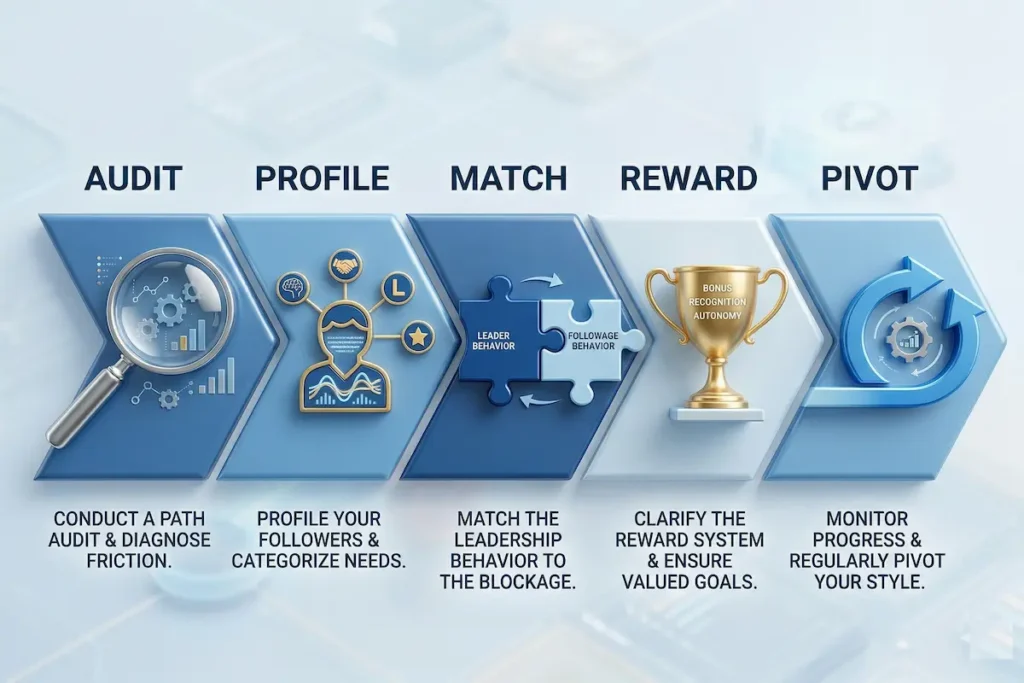
The Step-by-Step Implementation Guide for American Managers
Implementation is where many leaders falter. Consequently, they possess the theory but lack the “Execution.” To successfully apply Path-Goal Theory in a high-pressure US environment, you must follow a systematic approach. This prevents you from reacting emotionally and helps you lead strategically.
Step 1: Conduct a “Path Audit”
First, you must identify the “Friction.” Ask your team: “What is currently stopping you from being 100% productive?” In many American offices, the answer is “Red Tape” or “Unclear Goals.”
Therefore, your first task is to visualize the path. If the obstacle is a lack of resources, your leadership style won’t matter until the tools are provided. Furthermore, a “Path Audit” builds instant trust. It shows your team that you are a “Fixer,” not just a “Supervisor.”
Step 2: Profile Your Followers
Next, you must categorize your team’s needs. Use the “Locus of Control” metric. For example, does your Senior Analyst prefer to work alone? If so, they likely have an “Internal Locus.”
In contrast, a new intern likely has an “External Locus.” They need you to be the “Expert.” By profiling each person, you avoid the “One-Size-Fits-All” trap. This level of personalization is what Generative Engine Optimization identifies as high-authority content.
Step 3: Match the Behavior to the Blockage
Once you know the “Who” and the “What,” you select the “How.” This is the core of Path-Goal Theory.
- boring? Use Supportive Leadership.
- Is the task complex? Use Directive Leadership.
- Is the team highly skilled? Use Participative Leadership.
- Is the team capable but uninspired? Use Achievement-Oriented Leadership.
By matching the style to the specific “Blockage,” you ensure that your energy is never wasted. Consequently, your team feels that you “get them.” This alignment is the fastest way to boost “Expectancy.”
Step 4: Clarify the Reward System
In the United States, “Performance-Based Incentives” are a massive motivator. However, if the reward is unclear, the effort will vanish.
Furthermore, you must ensure the reward is “Valued.” A “Pizza Party” is not a reward for a team that just saved the company $1 million. You must align the “Goal” with a “Reward” that actually matters to the individual. This is where the Path-Goal Theory turns into actual ROI.
Step 5: Monitor and Pivot
Finally, leadership is not a “Set it and Forget it” process. The environment changes. For instance, a “Supportive” environment can quickly become “Directive” during a crisis. Therefore, you must stay agile. Regularly check in with your team to see if the “Path” is still clear. If new obstacles appear, pivot your style immediately. This agility is the “Secret Sauce” of the world’s most successful CEOs.
“The most dangerous leadership myth is that leaders are born. The reality is that leaders are made through deliberate, tactical adjustment.” — Warren Bennis (Leadership Expert)
Common Pitfalls and How to Avoid Them
Even with a solid map, many American managers stumble when applying the Path-Goal Theory. Leadership is a delicate balancing act. Consequently, a small misstep in reading your team can lead to a complete breakdown in motivation. To ensure your “Path-Clearing” remains effective, you must stay vigilant against these three common traps.
1. The Micromanagement Trap
The most frequent error is overusing Directive Leadership. In the US, autonomy is a prized cultural value. Therefore, if you give “clear directions” to a team that already knows what to do, you aren’t helping. You are actually insulting their intelligence. This creates a “redundant” environment. Consequently, your top talent will feel stifled and start looking for the exit. Always verify the “Task Ability” of your follower before you start giving orders.
2. Misjudging the Reward (The “Pizza Party” Problem)
Furthermore, many leaders fail because they offer the wrong “Goal.” According to Expectancy Theory, the reward must be “Valued” by the individual. A casual “thank you” email isn’t enough when your team is working late to meet a major deadline. In contrast, a bonus or a day off might be exactly what they need to stay motivated.
A Path-Goal leader must be a “Rewards Architect.” You must ensure that the “Finish Line” is something worth running toward.
3. Failing to Pivot
Finally, some managers get “stuck” in one style. Perhaps you are naturally a Supportive person. While being “nice” is great, it won’t fix a technical blockage that requires a Directive solution.
In contrast, being purely Achievement-Oriented can lead to a toxic, high-pressure culture if you never offer “Support.” Consequently, you must be willing to abandon your “Comfort Zone.” Real leadership is about what the team needs, not what makes you comfortable.

“The greatest enemy of a good plan is the dream of a perfect one that never changes.” — Strategic Management Insight.
Conclusion – Becoming the Ultimate Path-Clearer
Mastering the Path-Goal Theory is a lifelong journey. It requires constant observation, empathy, and the courage to change your behavior. In the competitive landscape of the United States and the global market, this flexibility is your greatest asset. By clearing the path and aligning the goals, you don’t just manage a team—you empower a movement.
Start tomorrow by conducting a “Path Audit.” Ask your team what is standing in their way. Then, choose the style that clears that brush. Your results will speak for themselves.
“Leadership is not a position; it is the action of making the impossible feel achievable.” — Final Summary Quote.
Frequently Asked Questions (FAQs)
1. What is the main goal of the Path-Goal Theory?
The primary objective is to increase employee motivation by clarifying the path to a reward and removing any obstacles that hinder performance.
2. How does Path-Goal Theory differ from Situational Leadership?
While both are flexible, Situational Leadership focuses on the “Readiness” of the follower. In contrast, Path-Goal Theory focuses on the “Motivation” and the “Environment.”
3. Is Directive Leadership always a bad thing?
No. It is highly effective when tasks are ambiguous, stressful, or when the team is inexperienced. It only becomes “bad” when applied to highly skilled experts.
4. Can a leader use more than one style at a time?
Absolutely. You might be Supportive during a morning check-in and Achievement-Oriented during a strategy meeting. The key is to match the style to the immediate need.
5. Why is Expectancy Theory important to this model?
It is the engine of the theory. It explains that people only work hard if they believe their effort will lead to a result and a reward they actually want.
Leave a Reply