
Two students walk out of the same ninety-minute lecture.
One forgets everything the teacher said after the first fifteen minutes. Another student spends the class half-watching and half-scrolling. That night, unprompted, he sits through four short videos on the same topic. He pauses twice to look something up and finally understands it.
They sat in the same room, heard the same teacher, and absorbed the same information, yet walked away with completely different outcomes.
For years, the easy explanation blamed the second student’s attention span, a symptom of ‘kids these days’ and their phones. I believed that story too, until I sat down with the actual research on how Gen Z Learn processes information.
However, what I found flips the explanation on its head: the second student didn’t fail to pay attention. The lecture failed to earn it.
That distinction changes how we should be teaching, training, and parenting this generation.
In our earlier piece on Who Is Gen Z, we looked at how this generation communicates, how they work, and how they see the world, noting both strengths and challenges for educators and leaders alike in diverse settings and contexts.
Specifically, this article explores how Gen Z actually learns in real settings, from desks to devices, and how that shapes instruction and feedback. It also explains what that means for the classroom, the training room, and the kitchen table where homework happens.
The Myth We Keep Repeating
You’ve probably heard the claim: Gen Z has an attention span shorter than a goldfish, eight seconds, sometimes quoted as low as 1.3. People repeat it in boardrooms, staff rooms, and family group chats as settled fact.
It isn’t settled, and it isn’t fact. The number has no verified scientific source, and a widely cited McKinsey analysis calls it out directly as a myth. What the research actually shows is more interesting than “they can’t focus.” Gen Z has built an extremely fast filter for deciding what’s worth their time.
That’s the same generation that will binge an entire Netflix season in one sitting, disappear into a three-hour YouTube rabbit hole, or spend a whole Saturday inside a video game with a rulebook longer than most school textbooks.
That’s not a broken attention span. Growing up surrounded by infinite content sharpened their selective attention instead.
Here’s the uncomfortable part for anyone standing in front of a classroom or a boardroom: that filter judges your lesson exactly the way it judges everything else on a screen. A forty-minute unbroken lecture doesn’t lose Gen Z learners because they’re incapable of sitting still.
It loses them because it fails the relevance test in the opening minute, and once that happens, no amount of authority in the room earns the attention back. Moreover, it fails the relevance test in the opening minute. Once that happens, no amount of authority earns the attention back.
Source: McKinsey & Company research, cited in Big Think, 2026
What Actually Changed: Gen Z Learn and the Rise of Micro-Learning
So if the long lecture isn’t working, what is?
Think back to that second student, the one who watched four short videos instead of rereading ninety minutes of notes. That instinct has a name: micro-learning. Short, focused lessons built around a single idea or skill, instead of one long session trying to cover everything at once.
This isn’t a Gen Z invention. Psychologists have understood the science behind it for decades: the forgetting curve, the well-documented tendency for freshly learned information to fade fast unless learners reinforce it in smaller doses over time. Micro-learning works with that curve instead of fighting it. Research on spaced, chunked learning consistently shows retention gains in the 25 to 60 percent range compared with a single long session.
Why It Clicks So Naturally With Gen Z
What makes this especially relevant for Gen Z is the world that trained them for it. TikTok, YouTube Shorts, and Instagram Reels taught an entire generation to absorb an idea, a technique, or a story in under sixty seconds, and to expect that same pace everywhere else, classrooms included. According to TalentLMS’s 2026 workplace learning benchmark, 76% of Gen Z employees say they’d be more engaged at work if their employer offered more short, on-demand learning instead of long training blocks.
What the numbers show:
- Learners consistently report preferring micro-learning over multi-hour traditional courses.
- Modules built around 5 to 10 minutes see meaningfully higher completion rates than longer sessions.
- Mobile-based micro-learning drives stronger daily engagement because it fits into gaps in a day. It does not demand a dedicated block.
Source: TalentLMS 2026 L&D Benchmark Report, via Engageli
The lesson here isn’t to make everything shorter for the sake of it. It’s to break big topics into smaller, self-contained units, each with its own clear payoff, rather than one long session that only makes sense once you’ve sat through the whole thing.
The Game Changer: Why Points and Progress Bars Work
Say the word “gamification” in a staffroom and you’ll usually get one of two reactions: enthusiasm, or an eye-roll about gold stars and participation trophies dressing up real work as play.
The research tells a more useful story than either reaction. A systematic review of classroom gamification studies found that when teachers thoughtfully build game elements, points, badges, levels, friendly competition, into lessons, engagement, motivation, and collaborative learning all improve. Multiple academic studies on gamified classrooms report gains not just in enjoyment but in actual academic performance and depth of understanding.
Why does something as simple as a progress bar move the needle? A few consistent reasons show up across the research:
- It makes progress visible. An abstract goal like “get better at algebra” becomes something trackable in real time.
- It gives immediate feedback. Instead of waiting a week for a graded test, a learner knows right away whether something clicked.
- It taps into intrinsic motivation. The best-designed systems build in curiosity and mastery, not just prizes.
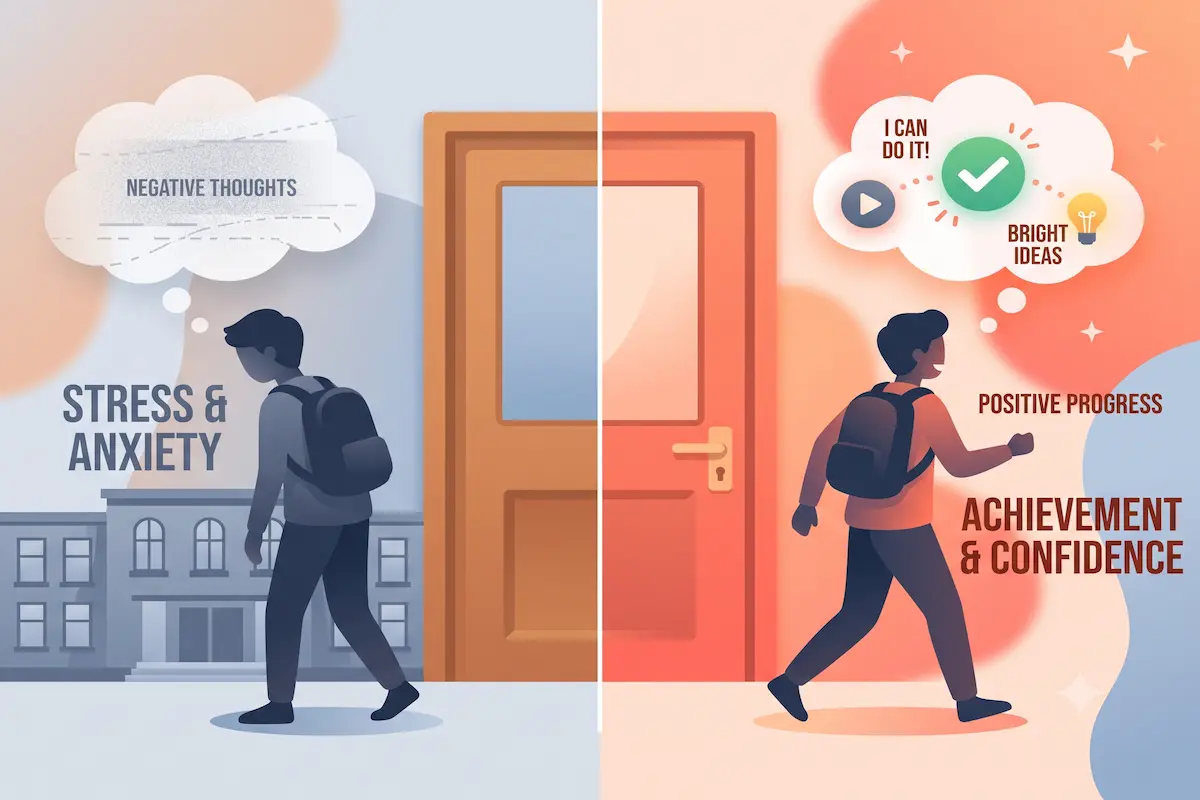
- It lowers the fear of failing in public. Getting something wrong inside a game and trying again feels nothing like getting it wrong in front of the whole class.
Source: Frontiers in Education, systematic review of school gamification research, 2024
Fair warning though: the same research found that badly designed competition can backfire, creating anxiety or unhealthy comparison rather than motivation. A leader board that humiliates the bottom five students isn’t gamification done well, it’s just public ranking with extra steps. The difference lies in whether the game reinforces the learning goal or quietly replaces it.
Why the Lecture Is Losing Its Grip
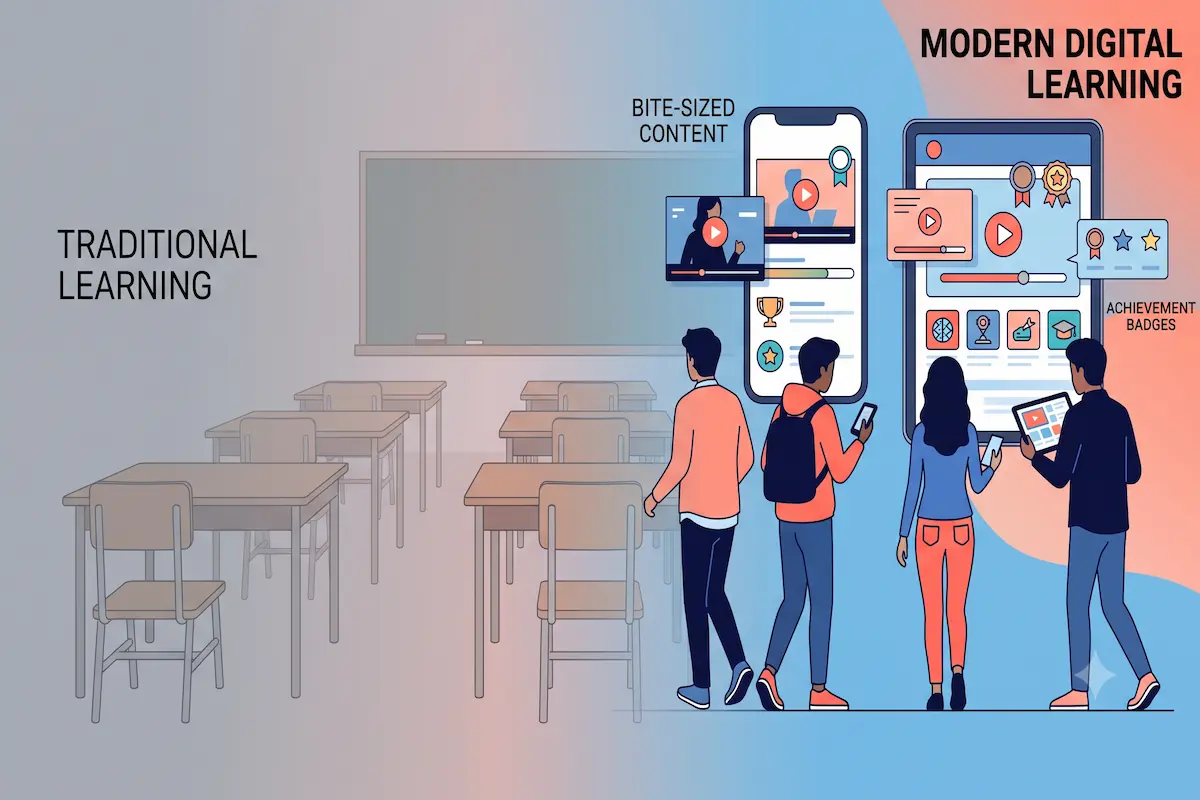
None of this is really an argument against depth. It’s an argument against one specific format: the long, one-directional lecture, where a single person talks while everyone else absorbs it in real time, in order, at the same pace, with no room to pause until the end.
Gen Z’s resistance to that format isn’t defiance — it’s mismatch. Research on Gen Z learners found that 68% prefer online learning tools for studying, and when researchers asked why, the top reasons weren’t “it’s easier.” They were flexibility and accessibility: the ability to pause, rewind, and revisit material on their own schedule. The same research uncovered a number educators shouldn’t brush past: 51% of Gen Z students said their teachers feel “out of touch” with how Gen Z actually learns.
Source: Generation Z Statistics report, worldmetrics.org, 2026
Read that number as a signal rather than an insult. A lecture assumes the room has no other option. Gen Z has always had another option, sitting one tap away on the same device on their desk.
Screens are already at the center of most of these conversations. If you’re navigating how much access is too much, our guide on the impact of mobile phones on children is a useful next read, and if you’re figuring out how to guide rather than control a Gen Z learner at home, our piece on parenting styles walks through what actually works.
A Parent’s and Teacher’s Practical Playbook
So what does teaching Gen Z the way they actually learn look like on a Tuesday afternoon? A few shifts that don’t require a budget, just a different structure:
- Chunk it. Break a topic into standalone five-to-ten-minute segments, each with one clear takeaway, instead of one long unbroken session.
- Front-load the why. Open with why this matters before diving into details. Gen Z’s attention filter decides relevance in the first few seconds, so give it a reason to say yes.
- Build in quick feedback loops. A short quiz or an instant right-or-wrong check after each chunk beats waiting until the end of a unit to find out what didn’t land.
- Let them revisit on their own schedule. Recorded videos, reusable notes, and searchable material respect the reality that Gen Z often learns best outside the classroom’s fixed timing.
- Use game mechanics sparingly and with purpose. A progress tracker or streak can build motivation, just make sure it celebrates the learning instead of replacing it.
A teacher can chunk a lesson with better planning. Additionally, a parent can turn a chore-based skill like cooking, budgeting, or fixing something into a five-minute how-to video. This replaces a one-time verbal explanation they must remember on the first try.
Even AI tools are becoming part of this shift. Our guide on what generative AI actually is helps you understand Gen Z used to learn.
The Catch: Micro-Learning Isn’t a Magic Fix
Shorter isn’t automatically better, and gamified isn’t automatically deeper. That distinction matters. Some ideas genuinely need sustained, uninterrupted thinking to take root: a novel, a mathematical proof, a piece of history that only makes sense as a connected whole. Chop everything into bite-sized pieces and you risk leaving a student with a pile of disconnected facts and no sense of how they fit together.
Remember the two students from the opening. The second one didn’t just watch four short videos and stop there. They paused, looked something up, and worked through the confusion themselves. That’s the real skill worth teaching: not just learning in short bursts, but building the muscle to go deep when a topic actually requires it, even in a world that constantly offers the shorter, easier option instead.
The most effective approach doesn’t choose between micro-learning and deep learning. It uses short, well-designed chunks to build the foundation, then deliberately makes room for the longer, harder thinking once that foundation is solid.
Final Thought
Gen Z didn’t reject the lecture out of disrespect. They grew up in a world that trained them to filter fast, expect relevance early, and demand a reason before investing their time, and most of us would probably learn the same way if someone had handed us a smartphone at age eight.
The parents, teachers, and employers who adapt to that reality, not by dumbing content down but by delivering it in a shape Gen Z can actually absorb, aren’t lowering the bar. They’re removing the friction between a good idea and the person who needs to hear it.
This is the same thread we picked up in Who Is Gen Z: a generation that isn’t broken, just built differently, and worth the effort to understand.
If this shift is playing out in your classroom, your team, or your own home, I’d genuinely like to hear about it. Drop your experience in the comments below, or reach out through our feedback page. And if you’d like more research-backed reads like this one, subscribe to the Chatterlane newsletter.
Enjoyed this article?
If you find the blogs helpful, you can support Chatterlane with a small contribution. Even a cup of coffee helps me continue creating useful, well-researched content.