

You studied for six hours last night. The chapter made sense. You even felt a little proud.
This morning, someone asks one simple question about it. Your mind goes blank.
If you have ever wondered, why do I forget what I study, you are not alone. School students, college students and exam aspirants all describe the same thing. The effort was real, but the memory is gone when it counts. Here is the good news. This does not mean you are lazy or have a weak memory. A 19th-century experiment explains it, and a 2015 replication confirmed it. Our earlier post on how Gen Z learns best mentioned this idea briefly. Here we look at it properly.
The short answer
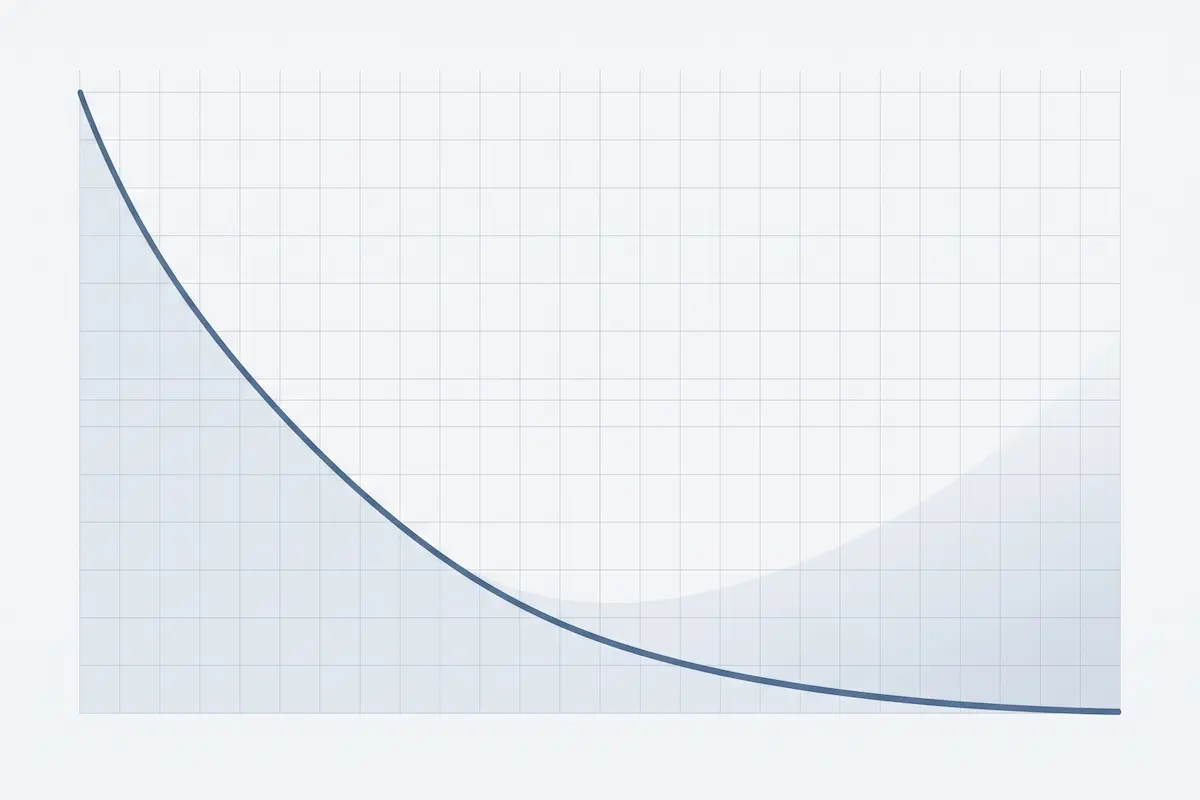
You forget what you study because memory fades quickly unless you use it again. German psychologist Hermann Ebbinghaus mapped this in the 1880s and called it the forgetting curve. Most of the drop comes early, then it slows. Spaced reviews and self-testing both slow the drop.
What is the forgetting curve, and is it real?
The forgetting curve is a graph of how fast memory fades after you learn something. It is real. A 2015 replication found a pattern close to the one Ebbinghaus reported in the 1880s.
How did Ebbinghaus measure forgetting?
Ebbinghaus tested himself on lists of nonsense syllables, such as “DAX” or “BOK”. He used nonsense so that old knowledge could not help him. First he learned a list. Then he waited, and later he tried to relearn it. The time he saved on the second try showed how much had stuck. He called this “savings.”
When he plotted the results, memory dropped steeply at first and then flattened out. Most of the forgetting happened early.
Did anyone check his results?
Could one man’s results be a fluke? Researchers Jaap Murre and Joeri Dros wondered the same thing. In a 2015 paper in PLOS ONE, one subject spent about 70 hours learning lists. He relearned them after 20 minutes, 1 hour, 9 hours, 1 day, 2 days and 31 days. The results looked similar to Ebbinghaus’s original data.
The authors also found the curve was not perfectly smooth. It seemed to tick upward after the 24-hour mark. The abstract does not explain why. Some summaries link this bump to sleep, but the abstract does not say so.
One secondary summary of the paper reports savings of roughly 47% after 20 minutes, about 32% after one day and about 4% after 31 days
What does the curve look like in daily life?
You learn the causes of the French Revolution on Monday evening. By Wednesday, the names and dates feel fuzzy. By next week, only the main idea is left.
Common confusion points
- The curve is not a law that says you lose a fixed share of everything. It came from one person at a time, using meaningless syllables.
- Real subjects differ. Material you understand may fade at a different pace, and the numbers vary from person to person.
Takeaway: The forgetting curve is a pattern, not a verdict. Memory fades fastest right after you learn, so that is when review helps most.
Why do I forget what I study?
You forget what you study mostly because you don’t revisit it in time and you study in ways that feel good but build weak memories. Four habits explain most of it.
1. You study it once and move on
The forgetting curve says memory fades fastest right after learning. If the first review comes a week later, much of the material is already gone. Shana Carpenter, lead author of a 2022 review in Nature Reviews Psychology, says forgetting is natural and you cannot stop it. You can only slow it down with spacing and retrieval practice.
2. You cram
Cramming means packing all your study into one block just before the test. It can get you through tomorrow’s quiz. It works poorly for next month’s exam. A 2006 meta-analysis in Psychological Bulletin, covering 317 experiments, found that spreading study over time beats massed study. It also found that the best gap between sessions grows as the test gets further away.
For example, picture a student who reads a biology chapter five times the night before. That student may feel ready. Two weeks later, they may recall less than a friend who read it twice, on two different days.
3. You reread instead of recall
Rereading feels productive because the page looks familiar. Familiar is not the same as remembered. In a 2013 review of ten study techniques, John Dunlosky and colleagues found that rereading and highlighting did not reliably boost performance. They recommended practice testing instead. Many students still use rereading and highlighting the most.
4. You trade sleep for study hours
Sleep appears to help memory settle after learning. A 2007 review by Robert Stickgold and Matthew Walker in Sleep Medicine covers this research. Still, scientists debate how it works and how big the effect is, so treat sleep as a helper, not a guarantee.
A common confusion point
Forgetting does not mean you studied wrong. Even top students forget. The difference is that they review before the memory is gone.
Takeaway: Forgetting comes from timing and method, not from a weak brain.
What most people are missing: why does rereading feel like learning?
Rereading feels like learning because the page looks familiar, and your brain reads familiarity as knowing. But recognizing a page is easier than recalling its content from a blank sheet. Exams ask for recall.
What is the fluency trap?
When you reread a chapter, the words flow easily. That smooth feeling tricks you into thinking the idea is stored. Psychologists call this the illusion of knowing. In their 2022 review in Nature Reviews Psychology, Carpenter, Pan and Butler suggest learners underuse spacing and retrieval practice partly because of false beliefs about learning. They also point to low awareness of these methods and the fact that they feel counter-intuitive.

Why does effort help?
Roediger and Karpicke ran a well-known 2006 study in Psychological Science. Students either reread a passage or practiced recalling it. A week later, the recall group remembered more.
Bigger evidence exists. A 2021 meta-analysis in Psychological Bulletin by Yang and colleagues combined 222 classroom studies with 48,478 students. Quizzing raised achievement by about half a standard deviation. That is a notable gain for a study habit that costs nothing.
A connection most pages skip
Here is a link most articles on this topic leave out. Short videos and bite-sized lessons feel smooth, which is why they suit so many students. Our post on how Gen Z learns best covers why. But smooth also means easy to forget. A five-minute clip watched twice is still rereading in a new format. Microlearning helps most when each chunk ends with a question you must answer from memory.
So the struggle to remember is not a sign that learning failed. It is the part that makes the memory stronger.
Takeaway: If studying feels too easy, you are probably reviewing, not remembering. Close the book and test yourself.
How to stop forgetting what you study
You can slow forgetting with three habits: review at spaced intervals, test yourself from memory, and sleep enough. Research supports all three, though no study gives one perfect schedule.
Step 1: Space your reviews
Review a topic soon after you learn it, then again after a longer gap. Then wait longer again. The 2006 meta-analysis by Cepeda and colleagues found the best gap depends on how far away the test is. A farther exam calls for wider gaps.
Carpenter’s team adds that no universal rule exists for the exact timing. So treat the plan below as a starting point, not a formula.
Step 2: Test yourself, don’t reread
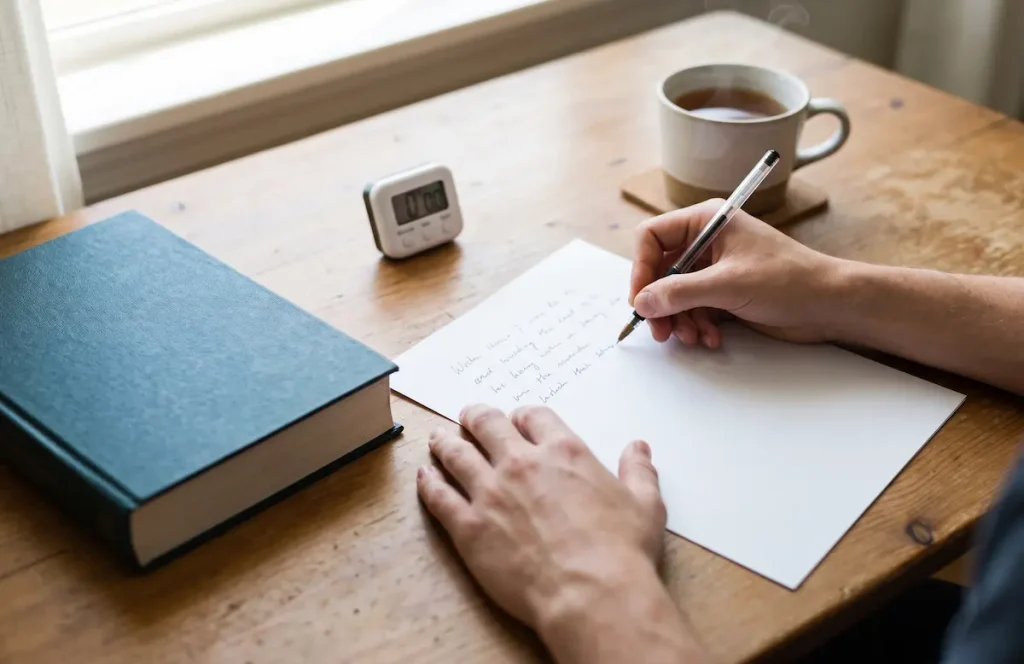
Close the book. Write down everything you remember, or answer practice questions. Then check your notes and fix the gaps. Dunlosky and colleagues (2013) rated practice testing and distributed practice as the two most useful techniques of the ten they reviewed.
Some easy ways to do this:
- Write a blank-page summary before you reread anything.
- Turn headings into questions and answer them aloud.
- Use flashcards, paper or an app.
- Do past exam papers under time limits.
Step 3: Protect your sleep
Sleep appears to help memory settle after learning, though scientists still debate the details. If poor sleep is a regular problem, our complete guide to insomnia explains causes and treatment options.
A sample 7-day plan
This is an example, not a research-proven schedule. Adjust it to your exam date.
| Day | What to do | Time |
| 1 | Learn the new topic. End with a blank-page recall. | 45 min |
| 2 | Recall Day 1 from memory first. Then check notes. | 15 min |
| 3 | Learn the next topic. Quick recall of Day 1. | 45 min |
| 4 | Recall Days 2 and 3 topics from memory. | 20 min |
| 5 | Practice questions on all topics so far. | 30 min |
| 6 | Redo only the questions you got wrong. | 20 min |
| 7 | Full recall of the week, then rest. | 30 min |
Notice what changes. Each session starts with recall, not rereading. The wrong answers tell you what to review next. A mind map can help you organize topics before you test yourself. Our list of the best mind mapping tools is a good place to start.
Common mistakes to avoid
- Waiting until the weekend. One long session is still cramming.
- Checking answers too soon. Try hard to recall first. The effort is the point.
- Quitting after a bad recall. Struggling means the memory is being strengthened, not that you failed.
Takeaway: Space your reviews, test yourself first, and sleep. Do these three things and forgetting slows down.
Why this matters right now
Students today can get a clean summary of any chapter in seconds. That makes the old trap easier to fall into, because reading a polished summary feels like learning. The forgetting curve does not care how neat the notes look.
Why is the problem growing?
Three things push students toward passive study.
- Easy summaries. AI tools, video recaps and shared notes make review material quick to get. Reading them is still rereading in a new form.
- Bigger syllabi. Competitive exams cover huge amounts of content. Students feel they must cover more, so they hurry past the review step.
- Constant switching. Phones pull attention away mid-session, so each study block gets shorter and thinner.
What happens if nothing changes?
Students keep putting in long hours and getting weak results. That can feel like a personal failure, so some start to believe they have poor memory. Carpenter’s 2022 review points to this gap: effective methods exist but remain underused.
There is a plus side. Spacing and self-testing cost no money and take no special tool. A student with a notebook and a timetable can start tonight.
What should students watch for?
Ask one question after every session: “Could I explain this tomorrow without my notes?” If the answer is no, the session needs a recall step.
The bigger picture: what the forgetting curve can’t tell you
The forgetting curve is a useful guide, but it has limits. It comes from lab tests on simple material, so real subjects behave differently. Scientists also still debate parts of the story, including sleep and the best spacing gaps.
What does the curve leave out?
Ebbinghaus and the 2015 replication both used nonsense syllables. Real study material has meaning, and meaning changes how fast memory fades. Murre and Dros’s replication used one subject, so the results show a pattern, not a rule for everyone.
Understanding also matters. Material you grasp well often sticks better than material you memorize word for word.
What is still debated?
- Sleep. Stickgold and Walker (2007) review evidence that sleep helps memory settle. Other researchers have questioned how strong that evidence is, and critics have published replies. So sleep is likely helpful, but the exact effect is not settled.
- The best spacing gap. Cepeda et al. (2006) found the ideal gap depends on the test date. Carpenter’s team says no universal rule exists. Any fixed schedule, including the table above, is a rough guide.
- Quizzing and anxiety. Frequent tests can stress some students, and researchers have studied whether practice tests raise test anxiety.
Who might need extra care?
Students with learning difficulties, attention problems or memory concerns may need help beyond study tips. If forgetting is sudden, severe or comes with other worries, talk to a doctor or a school counselor. This article is general education, not medical advice.
So should you trust the method?
Yes, with realistic expectations. Spacing and retrieval practice have strong support across many studies, as the 2021 Yang meta-analysis shows. They improve memory. They do not guarantee a perfect score.
Why does my child forget what they study?
Your child forgets for the same reason adults do: memory fades fast unless it is revisited, and rereading gives a false sense of progress. The fix is also the same. A parent can help with short, calm recall checks.
Is this normal for children?
Yes. The forgetting curve describes a general pattern in human memory, not a flaw in one child. Many children read their notes three times, feel ready, and still blank out in the exam. According to the Association for Psychological Science summary of the 2013 Dunlosky review, spacing and self-quizzing have helped students of all ages.
So a child who forgets is not careless. Most likely, no one has shown them a better method.
How can a parent help without nagging?

Keep it short and low pressure. Try these:
- Ask for a teach-back. “Explain today’s chapter to me like I’ve never heard of it.” Gaps show up fast.
- Quiz before dinner, not before bed. Ask three questions about yesterday’s topic. Skip the grades and the sighs.
- Spread the week. Two short sessions on different days beat one long evening.
- Keep bedtimes steady. Sleep appears to help memory, so one more late hour is rarely worth it.
If study time turns into daily arguments, our post on parenting styles explains how to guide a child without constant conflict. Carpenter notes that in the classroom examples she describes, teachers did not grade the quizzes, so a casual quiz at home is enough.
When should a parent seek help?
If your child struggles to remember everyday things, forgets suddenly, or seems very anxious about school, speak with a doctor or school counsellor.
Conclusion
If you keep asking yourself, why do I forget what I study, the answer is simple. Memory fades fastest right after learning. Ebbinghaus showed it in the 1880s, and the 2015 replication in PLOS ONE found a similar pattern.
You cannot stop forgetting. You can slow it down. Review soon, then again after longer gaps. Close the book and test yourself before you reread. Protect your sleep. The Association for Psychological Science summary of the 2013 Dunlosky review says spacing and self-quizzing are among the most useful study techniques. For the full evidence on spacing, see the 2006 meta-analysis by Cepeda and colleagues.
Keep your expectations realistic. These methods improve memory, but they do not guarantee a perfect score, and the best timing differs by person and subject. Start small tonight. Pick one topic from today and write down everything you remember without looking. Then check your notes and fix the gaps. If you want more research-based study guides, you can subscribe to the Chatterlane newsletter.
Frequently asked questions
Why do I forget what I study right after studying?
You forget quickly because memory fades fastest soon after learning, and rereading does not build strong recall. The forgetting curve shows this early drop. A short recall check within a day slows it.
How long does it take to forget what you learn?
It varies by person, subject and how well you understood it. In the 2015 replication, researchers tested memory from 20 minutes up to 31 days and saw the steepest loss early on. Real study material may fade at a different pace.
Does sleep help you remember what you study?
Sleep appears to help memory settle after learning, according to a 2007 review by Stickgold and Walker. Scientists still debate how strong the effect is. Treat sleep as a helper, not a guarantee.
Is cramming ever a good idea?
Cramming can help you pass a test tomorrow, but it works poorly for long-term memory. A 2006 meta-analysis by Cepeda and colleagues found that spaced study beats massed study. If you must cram, add a recall check afterward.
How often should I revise to stop forgetting?
There is no single correct schedule. Review soon after learning, then use longer gaps each time. Carpenter and colleagues say no universal rule exists, so adjust the plan to your exam date.
Why does my child forget what they study?
Children forget for the same reasons adults do: memory fades without review, and rereading feels productive but is not. Short teach-back chats and spaced quizzes at home can help. If forgetting seems sudden or severe, speak to a doctor or school counselor.
Leave a Reply