
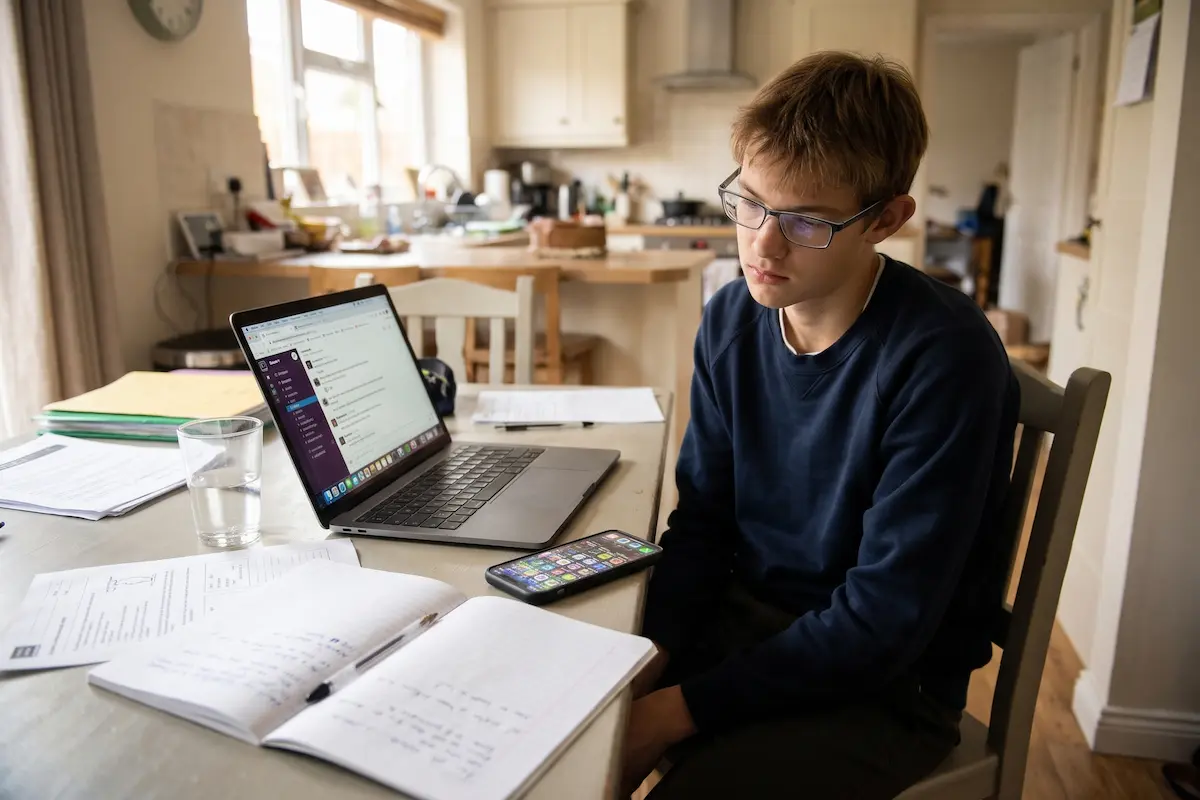
Your 15-year-old is at the kitchen table with a laptop open. Is that homework, or is it a group chat with a spreadsheet tab for cover? From across the room, you honestly can’t tell.
That everyday guessing game is exactly what a new set of international results tries to put numbers on. On September 8, 2026, the OECD released the results of PISA 2025, the largest round of this test so far. Alongside the usual scores, it looked at how students use devices, and for the first time it tested how well they learn and solve problems in a digital setting.
Headlines will mostly be about rankings. This guide is about something more useful for a parent, teacher or school leader: what the results say about screens and AI, and just as important, what they can’t say.
The short answer
PISA 2025 results: The OECD reports that reading and mathematics reached the lowest average levels it has recorded, while science results held steady between 2022 and 2025. On screens, the OECD says devices used for learning at school went with better science results up to a point, and devices used for fun during class went with sharply lower results. PISA is a snapshot of 15-year-olds, so these are links, not proof that screens or AI caused anything.
In the US: NCES reports scores of 502 in science and 463 in mathematics, neither significantly different from 2022, and 490 in reading, down from 504.
What is PISA, and who took it?
PISA stands for the Programme for International Student Assessment. It is run by the OECD, an organization of mostly wealthy democracies, roughly every three years. It tests 15-year-olds, an age at which students in many countries are nearing the end of compulsory schooling.
The test doesn’t check whether students memorized a school syllabus. It asks them to use what they know on unfamiliar problems, such as reading a graph or judging whether a source can be trusted.
Here is what makes the 2025 round different:
- Size. According to the OECD, more than 760,000 students took part, in 91 countries and economies. It is the biggest PISA so far.
- Main subject. Science was the main focus. Reading and mathematics were smaller parts of the test.
- New this time. PISA 2025 added a test of how students learn and solve problems in the digital world.
- The US report. In the United States, the National Center for Education Statistics (NCES) runs the study. It released its own report, Highlights of PISA 2025 U.S. Results, on the same day as the OECD.
Takeaway: PISA is a big, carefully run snapshot of 15-year-olds. It is not a report card on any one school or student.
What did PISA 2025 find?
The OECD’s own headline is blunt. Its press release says students’ reading and mathematics performance declined sharply across the OECD, reaching the lowest average ever recorded in both. It also says that one in five 15-year-old students is now a low performer in science, mathematics and reading, up from 16% in 2022.
Science tells a calmer story. In the OECD Secretary-General’s launch speech, science results held steady between 2022 and 2025. His own summary of the whole picture was one word: mixed.
So there are two things to hold in your head at once. Reading and maths slipped to record lows on the OECD average, and science did not fall further.
How did US students do?
According to NCES, US 15-year-olds scored 502 in science, which is not significantly different from the 2022 average. In reading they scored 490, lower than the most recent comparable US average of 504 in 2022. In mathematics they scored 463, which is not significantly different from 2022. So in the US, reading is the subject that clearly slipped.
Takeaway: The OECD average fell in reading and maths and held in science. In the US, reading fell from 504 to 490, while science and maths were not significantly different from 2022.
What does PISA 2025 say about screens and learning?
The short version: it depends on what the screen is being used for, and for how long.
In his launch speech, the OECD Secretary-General said students who used devices for learning at school tended to have better science results, but only up to a point. Past that point, results started to fall. He also said that when students used devices for fun during class, results fell sharply.
That is more useful than the usual “screens are bad” or “screens are fine” argument, because it separates two very different habits.
| Use of a device | What the OECD reports | What it does not tell us |
| For learning at school | Went with better science results, up to a point | Whether the devices caused the better results |
| Too much of it | Results began to fall beyond a threshold | Where your child’s own tipping point is |
| For fun during class | Went with sharply lower results | Whether distraction is the reason, or something else |
Why might the results look this way?
PISA can’t answer that. Distraction, fewer breaks from the screen, or less teacher attention are all plausible stories. None of them is a finding. Treat them as questions to ask, not conclusions to repeat.
How to read this at home
A laptop open at the kitchen table is not the problem or the solution. What matters more is the task on the screen and whether the work is finished. A teen researching a history essay and a teen scrolling a video feed look the same from across the room.
Takeaway: Purpose beats hours as a starting question. Ask what the screen is being used for before you ask how long.
What does PISA 2025 tell us about AI?
Less than most headlines suggest. That is worth saying plainly.
The OECD describes PISA 2025 as the first round to test how students learn and solve problems in the digital world, and says the study looks at the use of artificial intelligence. What exists today is a baseline, not a verdict on AI tools. This guide doesn’t quote AI-specific numbers, because the clearest new data point is about something slightly different.
Here is what you can safely take from it:
- The new test measured problem-solving, not AI use. NCES reports that US 15-year-olds scored 513 on the digital-world test of computational problem-solving, above the OECD average of 500. Students took two 30-minute units in interactive digital settings. It is a first baseline, so there is no earlier US result to compare it with.
- PISA can’t yet show whether AI helps or hurts. Seeing how a tool changes learning takes results over time, and this is the first round.
- Experts urge caution. Jonathan Seiden of Vanderbilt University, quoted by K-12 Dive, said AI tutoring tools are not magic bullets, and warned that badly rolled-out tools could widen gaps between stronger and weaker students.
If you want practical help with AI and study, a good place to start is the same idea we explain in Why Do I Forget What I Study?: try to recall something from memory before you look at the answer. An AI tool can help you practice that, but only if you do the recalling.
Takeaway: PISA 2025 starts the AI conversation with data. It doesn’t end it.
What can’t PISA 2025 tell us?
This is the section most news stories skip, and it is the one that keeps you from repeating a headline that turns out to be too strong.
It shows links, not causes
PISA takes one picture of 15-year-olds at one moment. When the OECD says device use “went with” better or worse results, it is describing a pattern. It is not saying one thing caused the other. A student who struggles in class might also drift to a phone, and the screen would get the blame for something that started elsewhere. Device-use findings also rely on what students say about their own habits, and self-reported numbers are never exact.
Not every country’s data is equally firm
The OECD flags some countries because one or more of its sampling standards was not met, and it says caution is required when interpreting their estimates. The countries flagged are Albania, Canada, the Netherlands, New Zealand, Norway and the United States. That doesn’t make the results wrong. It means you should hold them a little more loosely.
Scores are estimates
Average scores come with a margin of error. A small change between 2022 and 2025 may not be statistically meaningful. Both the OECD and NCES say which changes are significant, so use their wording, not your own rounding.
Rankings compare very different systems
A country’s place in a league table says little about a single school or family. Differences in who is tested, in school systems and in how the test is run make small gaps hard to read.
Takeaway: Quote PISA with phrases like “linked to” and “the OECD reports.” Skip “proves” and “causes.”
What can parents do this week?
You don’t need to rebuild your home rules because of one report. A few small, low-drama changes fit what the OECD describes.
- Ask about the task, not the minutes. “What are you working on?” gets a better answer than “How long have you been on that?”
- Separate learning screens from fun screens. If one device does both, agree on a rule for homework time, such as notifications off until the work is done.
- Check one assignment together. Pick a single piece of homework this week and watch how your teen actually uses the device to do it. You’ll learn more in ten minutes than from any survey.
- Add a recall step. After a study session, ask your teen to explain the topic from memory before opening the notes. Our guide to why we forget what we study shows how, with a simple 7-day plan.
- Keep short-form learning honest. Quick videos and bite-sized lessons can work, as we explain in how Gen Z learns best, when each one ends with a question your teen has to answer.
- Talk to the school. Ask the teacher how devices are used in class and what the rules are for phones during lessons.
If your teen seems very anxious, unusually withdrawn or is struggling to cope, talk to their doctor or the school counselor. A study tip won’t cover that.
Takeaway: Small, specific habits beat big rules. Start with one this week.
What can teachers and schools do?
Schools already juggle policies on phones, laptops and AI. The OECD’s screen finding gives them one clear question to test any rule against: does this use of a device serve the lesson?
- Name the purpose of every device moment. “Use your laptop to annotate the source” is a learning use. “Laptops out” is not.
- Set a clear line for off-task use. Since the OECD links fun use of devices in class to sharply lower results, a shared, simple rule is easier to keep than a long policy.
- Build in recall. Start a lesson with a no-notes question on last week’s topic. It takes five minutes and doubles as a check for understanding.
- Be specific about AI. Tell students which tasks may use AI, which may not, and why. Vague rules produce guessing, and guessing produces disputes.
- Track your own data. Before changing a policy, look at what is actually happening in your classrooms, not only at what a national report says.
Takeaway: A rule students can explain in one sentence is a rule they are more likely to follow.
Around the world: how other countries are reading the results
The OECD average hides a lot of variety. A few things are worth knowing if you read international coverage next to American coverage.
- Many countries publish their own report. Canada’s results are posted by the Council of Ministers of Education, Canada (CMEC). Scotland scheduled its national report for the same day as the OECD release, September 8, 2026. In the US, NCES does the same.
- Some countries joined in a bigger way. Zambia’s examinations council described PISA 2025 as the first time its students’ results were measured on the full global scale, according to the Lusaka Times.
- Flagged data isn’t the same as bad data. New Zealand is one of the countries the OECD flags for sampling standards, and the OECD advises caution with its estimates. That is a good reminder to read every country’s numbers with the same care, including your own.
- Everyone is asking the same screen question. An international pattern on devices doesn’t guarantee your own school system matches it, so check local data before you act on it.
Takeaway: Compare countries cautiously. Different school systems, different samples, different rules.
Frequently asked questions
Did PISA 2025 scores go down?
On the OECD average, reading and mathematics fell to the lowest levels the OECD has recorded, according to its press release. Science results held steady between 2022 and 2025. In the US, NCES reports science at 502 and mathematics at 463, neither significantly different from 2022, and reading at 490, down from 504.
What does PISA 2025 say about screen time and learning?
The OECD says using devices for learning at school went with better science results up to a point, after which results fell. Using devices for fun during class went with sharply lower results. These are links in one snapshot, not proof that screens caused the differences.
Does PISA 2025 show that AI hurts or helps students?
No. PISA 2025 is the first round to test learning in the digital world, so it gives researchers a starting point. It can’t yet show whether AI tools help or harm learning over time. Experts quoted by K-12 Dive urge caution about treating AI tutoring as a quick fix.
What does PISA 2025 mean for US parents?
It is a reason to ask what your teen’s screen is being used for, not only how long it is on. In the US, reading is the subject that clearly slipped, so a short daily reading habit is worth protecting. Talk to your child’s school about device rules, and try small habits like a recall step after study.
How reliable are the PISA 2025 results for the United States?
The OECD flags the United States, along with Albania, Canada, the Netherlands, New Zealand and Norway, for not meeting one or more sampling standards, and says caution is required when interpreting those estimates. The results are still useful, as long as you quote them with that in mind.
What is PISA?
PISA is the Programme for International Student Assessment, run by the OECD roughly every three years. It tests 15-year-olds on how well they apply what they know in science, reading and mathematics. The 2025 round covered 91 countries and economies and more than 760,000 students.
Sources
- OECD (Sep 8, 2026). PISA 2025 Results (Volume I): Future-Ready Students. DOI: 10.1787/73451bc5-en.
- OECD (Sep 8, 2026). PISA 2025: Students’ reading and mathematics performance declined sharply across the OECD (press release).
- OECD Secretary-General (Sep 8, 2026). International launch of PISA 2025 (speech).
- OECD Education GPS. Important note regarding countries participating in PISA 2025.
- National Center for Education Statistics (Sep 8, 2026). Highlights of PISA 2025 U.S. Results, NCES 2026-032.
- K-12 Dive. From science to screen time: 4 key takeaways from the latest PISA results.
- Lusaka Times (Sep 7, 2026). OECD to release PISA results: ECZ.
- Scottish Government (2026). Timetable for publication of PISA results: FOI release.
- Council of Ministers of Education, Canada. PISA 2025 (Canada).
Related reading on Chatterlane: Why Do I Forget What I Study? Fix the Forgetting Curve | How Gen Z Learns Best with Microlearning and Gamification | 10 Best Mind Mapping Tools for 2026
Leave a Reply