
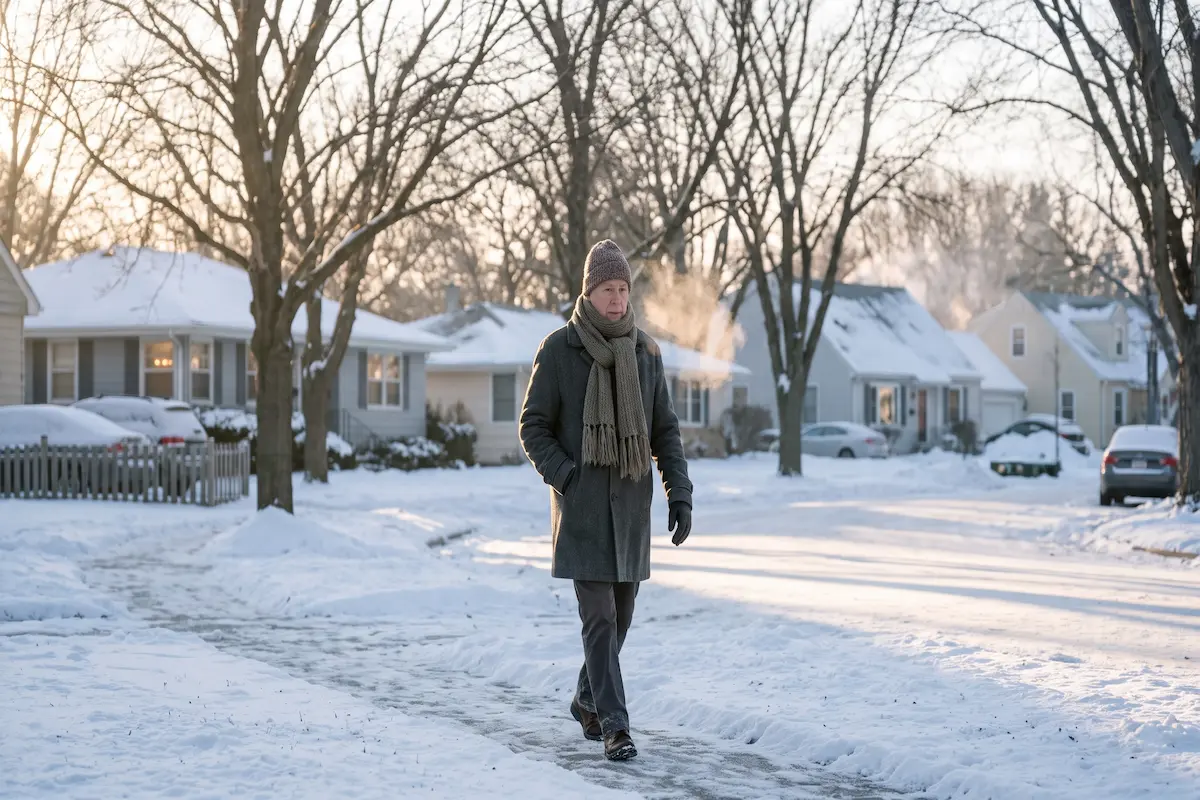
This article is general information. It is not medical advice.
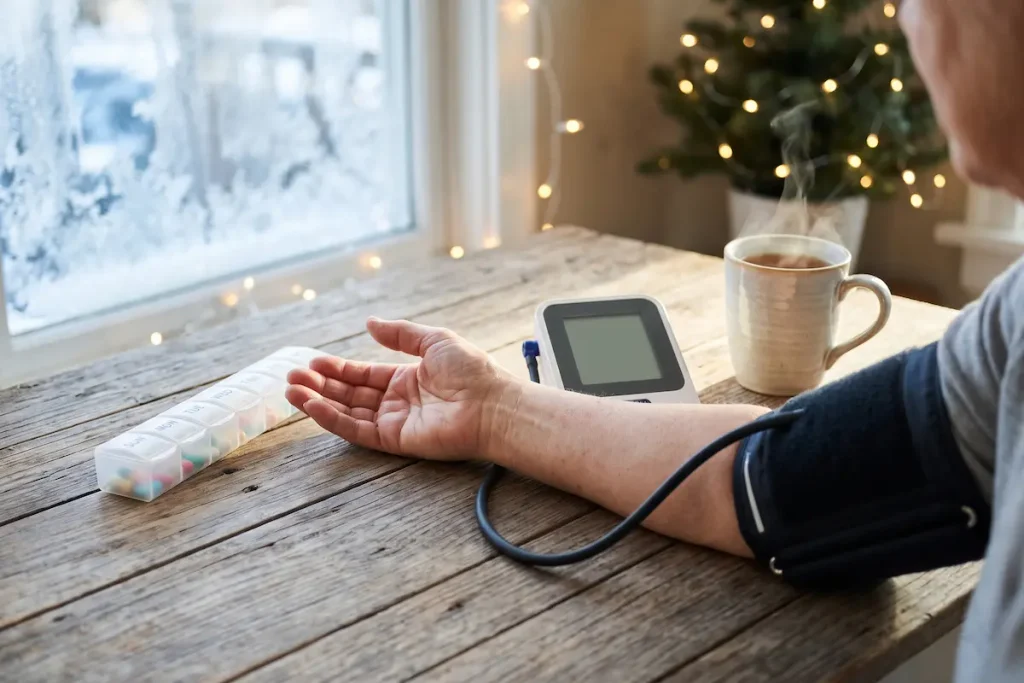
Why does a season of lights, family meals and time off send so many people to the hospital? Maybe you have felt your chest tighten while carrying bags in the cold. If so, you may have wondered the same thing. Heart attack risk in winter is real, and doctors see the pattern every year.
Cold air is one part of the story. Rich food, extra alcohol, stress and missed medicine are others. Many people also wait too long to get help, because the holidays feel busy. This matters now, because the cold months are starting for many readers. Small habits can lower the strain on your heart. First, here is what the evidence says.
Who this is for: adults who want to understand seasonal heart risk, and family members who help older relatives. Who should be extra careful: people with heart disease, high blood pressure, diabetes or high cholesterol, and anyone who has had a heart attack or stroke.
What raises heart attack risk in winter?
Cold weather narrows blood vessels and raises blood pressure, so the heart works harder. Holiday habits add to the load: big meals, alcohol, stress and missed medicine. Together, these can set off a heart attack in people who already have clogged arteries or other risk factors.
The cold effect is simple. To keep the body warm, blood vessels narrow and limit blood flow to the skin. According to American Heart Association (AHA) News, this raises blood pressure. The same report notes that the risk of a heart attack is six times higher in the week after the flu. Cold weather also sends people indoors, where infections spread more easily.
The holidays add a second layer. A 2004 study in Circulation found extra heart deaths at Christmas and New Year, on top of the usual winter rise. So the season and the holidays may work separately.
For example, picture someone with narrowed heart arteries who shovels snow after a big meal. Cold, effort and a full stomach all hit at once. As a result, small daily habits can matter more in the cold months.
Still, heart attack risk in winter is not the same for everyone. Most people get through winter without a heart attack. The people who need the most care are those with heart disease, high blood pressure, diabetes or high cholesterol.
Does cold weather raise blood pressure?
Yes, cold weather can raise blood pressure. When the temperature drops, blood vessels narrow, and the heart has to push blood through tighter space.
Doctors call this narrowing vasoconstriction. It is a normal, protective reflex. The body holds heat in its core by cutting blood flow to the skin. A heart doctor quoted by AHA News in December 2023 said this response raises blood pressure. On its own, she added, that can raise the risk of a heart attack or stroke.
Effort makes it worse. An AHA release in December 2022 explained that cold can raise blood pressure while it narrows the heart’s own arteries. Physical effort then speeds up the heart rate. So three strains can land together. That is the core of how cold weather and heart strain connect.
Real-world data point the same way. A 2023 AHA conference abstract reviewed records of 60,676 adults treated for high blood pressure at six U.S. health care centers. In winter, average systolic pressure (the top number) was up to 1.7 points higher than in summer. The share of patients with blood pressure under control fell by up to 5%.
The abstract is not peer-reviewed, so treat the numbers as early. Separately, Fortis Healthcare, an Indian hospital group, says in its patient material that winter heart attacks happen more often in the morning.
For example, imagine a person with treated high blood pressure. In summer, their readings sit in a safe range. In January, those readings may creep up. The abstract’s authors suggested that people with high blood pressure may benefit from regular checks in winter, along with more activity and better nutrition.
Not everyone faces the same risk. The AHA abstract looked only at adults already treated for high blood pressure, so its findings apply most to that group. If you are in it, track your numbers and tell your doctor about changes. Do not change your medicine on your own. For a deeper look, read our High Blood Pressure guide.
How do the holidays add to heart risk?
The holidays add risk through food, alcohol, stress and delayed care. These habits strain the heart on top of the cold.
The numbers show a real pattern. The 2004 Circulation study reviewed 53 million U.S. deaths from natural causes over 26 years. Heart deaths outside the hospital peaked on December 25, December 26 and January 1. The authors counted about 42,000 extra deaths in the holiday period. They said that people putting off care may have played a part.
Can rich food, salt and stress strain the heart?
Yes, they can, mostly through blood pressure. AHA News reported in 2022 that processed foods are the main source of sodium. A nephrologist quoted in that report named holiday hams as an example. The AHA suggests up to 1,500 mg of sodium a day for most adults, while federal guidelines set a 2,300 mg limit. For more on cholesterol, see our High Cholesterol guide.
Stress adds to the pile. In AHA News, Dr. Robert Kloner, a heart doctor, pointed to a link between emotional upset and heart disease. Travel, money worries and family tension all count.
What is holiday heart syndrome?
Holiday heart syndrome is an irregular heartbeat, often atrial fibrillation (AFib), after heavy drinking. Dr. Philip Ettinger and colleagues described it in 1978. According to StatPearls, a medical reference, it can also happen to people who rarely drink but binge now and then.
In 2024, the European Heart Journal published the MunichBREW II study. Researchers monitored young adults’ hearts for 48 hours around binge drinking. Heart rate rose, and ten people had notable rhythm problems. These mostly appeared in the hours after drinking stopped. The study followed people for only two days, so it shows short-term effects.
What are holiday heart syndrome symptoms?
The symptoms match AFib. According to the AHA, they can include:
- a racing, fluttering, pounding or irregular heartbeat
- tiredness, dizziness or lightheadedness
- shortness of breath or fainting
- anxiety
Some people feel nothing at all. The University of Arizona’s Sarver Heart Center says episodes often fade within a day. Still, AFib raises the risk of stroke, so see a doctor if it happens. Chest pain is different. Call 911.
Why do skipped medicines and alcohol matter?
Holiday routines can throw off blood pressure medicine schedules, AHA News reported in 2022. A nephrologist quoted in that report suggested carrying a pill organizer and setting an alarm. Do not stop or change doses without your doctor.
Alcohol needs a plain word too. It may feel warming, but Dr. Thomas Waters, an emergency medicine specialist at Cleveland Clinic, says you lose body heat to the outside faster. AHA News also notes that drinking too much can raise blood pressure. People with AFib should ask their own doctor what level of drinking is safe for them.
What does air pollution have to do with the heart in winter?
Dirty air may raise heart attack hospital visits in winter, according to early research from Utah. Cold weather often traps polluted air near the ground, so winter air can be worse.
Fine particles, called PM2.5, measure 2.5 micrometers across or less. They come from car exhaust, factories and fires. In winter, a weather pattern called an inversion traps pollution from human sources. The air near the ground then stays dirty for days.
At the 2023 AHA Scientific Sessions, researchers presented a study of nearly 22,000 adults. All were treated at 11 hospitals along Utah’s Wasatch Front between 1999 and 2022. On winter days with orange-level air quality, same-day heart attack hospital admissions were about 10% higher than on green-level days. Orange means unhealthy for sensitive groups, such as people with heart or lung disease. Green means little or no risk. You can read the details in the AHA news release.
This finding has limits. It was a preliminary abstract, and the AHA notes that such abstracts are not peer-reviewed. The researchers also lacked data on each person’s own exposure. So the study shows a link but cannot prove cause.
What can you do? The lead author, Dr. Benjamin Horne, advised people with chronic conditions to limit outdoor exercise when PM2.5 is high and to exercise indoors instead. He also advised taking blood pressure, diabetes, cholesterol and blood-thinning medicines as prescribed on those days.
Readers in North India may recognize this pattern. A 2022 PLOS ONE analysis of Delhi data from 2016 to 2018 found that winter was the city’s worst season for air pollution. That study looked at hospital visits for breathing problems, not heart attacks. So the Utah findings are a useful warning, not a Delhi result.
Why this matters right now
Seasonal risk builds fast, and heart attack risk in winter often peaks in the weeks around the holidays. In the Northern Hemisphere, cold weather, short days and the holiday calendar arrive within weeks of each other. Dr. Robert Kloner told AHA News in 2020 about a Los Angeles County analysis. In it, coronary heart disease death rates were highest in December and January and lowest in summer and early fall.
The 2004 Circulation authors also found that the excess in holiday deaths was growing larger over time. So the level of risk is not fixed. It may keep rising unless people change how they act during the season.
Acting early is simple. Check your blood pressure, refill your medicines and plan for snow before the first cold snap arrives.
What most people are missing
Most advice on heart attack risk in winter blames the cold alone. The evidence points to two separate layers. One is the body’s response to cold. The other is behavior, such as drinking, skipped medicine and waiting too long for care.
What does New Zealand tell us?
New Zealand shows how the layers come apart. Christmas falls in summer there. Yet a study in the Journal of the American Heart Association found about 4% more heart deaths outside hospitals than expected over the Christmas period. The researchers used 25 years of data, from 1988 to 2013. So the holidays carry risk even without cold.
Think of it as two dials. Cold turns up the strain on blood vessels. The holidays turn up the chance that a warning sign gets ignored. In a Northern winter, both dials rise together. In New Zealand, only one does. That may explain why advice about staying warm can miss half the problem.
Does winter heart risk reach mild places?
Winter risk also reaches mild places. AHA News noted that the winter rise shows up in frigid Alaska and sunny California alike. A later AHA News report added that the effect was stronger in areas where the weather is usually milder.
A note for Southern Hemisphere readers: your winter runs from about June to August, and the same cold effects apply then. The New Zealand data also show that a December holiday spike can happen in warm weather. So the holiday habits in this article matter for you too.
Some common beliefs also get in the way. Here are four, with what the sources say.
| Myth | Fact |
| Heart attacks in winter only happen in very cold places. | AHA News says the winter rise shows up in Alaska and California alike. New Zealand data show a holiday spike in summer. |
| A heart attack always starts with crushing chest pain. | AHA materials say most heart attacks start slowly, with mild pain or discomfort. |
| Alcohol is a good way to warm up. | Cleveland Clinic’s Dr. Thomas Waters says alcohol creates a feeling of warmth while you lose body heat faster. Heavy drinking can also trigger AFib. |
| A snow blower makes clearing snow safe for the heart. | AHA experts say studies show higher heart attack risk even with automatic snow blowers. |
How can you shovel snow safely with heart disease?
If you have known or suspected heart disease, the AHA advises getting someone else to remove your snow. If you must shovel, start slowly, pace yourself and push the snow instead of lifting it.
Shoveling is mostly arm work, which taxes the heart more than leg work. Dr. Joshua Latzman explained this in an AHA release in February 2026. People also tend to hold their breath when they lift heavy loads. That sharply raises heart rate and blood pressure. Meanwhile, cold air narrows blood vessels throughout the body.
Many heart events strike people who are usually inactive. For example, a sedentary person who clears a driveway after a storm faces a big jump in strain. Dr. Latzman said people with risk factors should not shovel at all. These include diabetes, high cholesterol, high blood pressure, and a past heart attack, stroke, bypass surgery or angioplasty.
If you do shovel, the AHA release suggests these steps:
- Start gradually and pace yourself.
- Cover your mouth and nose, and wear layers, a hat and gloves.
- Push or sweep the snow rather than lifting and throwing it.
- Use a snow blower if you have one, but know that studies link blowers to heart attacks too.
- Take extra care when the wind blows, because wind makes the cold feel worse.
- Stop at once if you feel chest pain or pressure, lightheadedness or palpitations.
Call 911 if the symptoms do not ease soon after you stop.
Is cold weather exercise safe for your heart?
Exercise in the cold is safe for many people, but it needs planning. The AHA says there is no reason to stop being active when the temperature drops. It also warns that effort in the cold puts extra strain on the heart. So people with heart disease should talk to a doctor first.
The benefits are real. The AHA recommends at least 150 minutes of moderate activity a week. Cooler air also means no heat or humidity to deal with. The risk comes from sudden hard effort, especially when you are out of shape.
These habits help:
- Dress in layers, and take breaks.
- Drink water even if you do not feel thirsty.
- Choose indoor options when it is icy, such as mall walking, dancing or stair climbing.
- Go out in pairs, because ice makes falls more likely.
What are the warning signs of a heart attack in women?
Chest pain or discomfort is the most common heart attack sign in both women and men. Women are more likely to also have shortness of breath, nausea or vomiting, and back or jaw pain.
The AHA says many heart attacks start slowly, with mild pain or discomfort. Common signs include:
- chest pain or discomfort
- pain or discomfort in one or both arms, the back, neck, jaw or stomach
- shortness of breath, with or without chest discomfort
- a cold sweat, nausea or lightheadedness
The signs can be easy to miss in women. The U.S. Office on Women’s Health says women are more likely than men to have nontraditional symptoms. They are also more likely to have silent heart attacks. The AHA’s guide to heart attack symptoms in women says the signs may not be obvious and can be confusing. Even so, the outcome can be deadly if help comes late. For example, nausea or back pain may feel like a stomach bug or a pulled muscle.
Stroke needs the same quick action. The AHA lists these warning signs:
- sudden numbness or weakness of the face, arm or leg, especially on one side
- sudden confusion or trouble speaking
- sudden trouble seeing in one or both eyes
- sudden trouble walking, dizziness or loss of balance
- a sudden, severe headache with no known cause
How can you protect your heart in winter?
You can lower heart attack risk in winter with a short set of habits. None of them replaces your doctor’s advice. Use this checklist:
- Dress in layers, with a hat, gloves and warm socks. Covering your mouth and nose can also help, according to the AHA.
- Get your flu shot. A heart doctor quoted by AHA News said everyone needs flu and COVID shots.
- Take heart and blood pressure medicines on schedule, and pack extra when you travel.
- Check your blood pressure more often, and ask your doctor if your doses need a change.
- Ask a pharmacist before taking cold or flu medicine if you have high blood pressure, as the AHA advises.
- Eat meals lower in salt and fat, and keep alcohol low.
- Stay active indoors when it is icy or the air is polluted.
- Let someone else clear the snow, or pace yourself if you cannot.
- Do not put off care for symptoms because of holiday plans.
When should you call 911 or see a doctor?
Call 911 right away if you think you may be having a heart attack or a stroke. The AHA says minutes matter. If you live outside the United States, call your local emergency number.
Do not wait to see if the symptoms pass. Delays are one reason the holidays carry extra risk. Describe your symptoms to the operator and say that you may be having a heart attack. If someone collapses and does not respond, call for help and start Hands-Only CPR. The AHA says to push hard and fast in the center of the chest.
Book a regular visit if you notice any of these:
- home blood pressure readings that creep up
- a racing or fluttering heartbeat that comes and goes
- new tiredness or shortness of breath
- a low supply of your medicines
- plans to start or change winter exercise when you have heart disease
The bigger picture and what could happen next
Winter heart risk returns every year because cold, holidays and habits return together. Seeing the two layers helps you act on the one you can control.
What could happen next? Cold snaps, dirty-air days and holiday parties will keep overlapping for many people. If you keep blood pressure, medicines and alcohol in check, the cold has less to push against. If symptoms get ignored, the holiday delay can raise the stakes. These are fair takeaways from the studies above. They are not guarantees. Researchers still debate how much each factor adds. Several findings also come from data that cannot prove cause.
Conclusion
Heart attack risk in winter comes from two layers: cold that strains blood vessels, and holiday habits that add risk or delay care. You can act on both. Keep warm, take your medicines, check your blood pressure, pace your effort and watch your drinking. Learn the warning signs, including the quieter ones that women may feel. Above all, call 911 early instead of waiting for the holidays to end. If you have heart disease or other risk factors, talk with your doctor about a winter plan.
Take one step this week. Check your blood pressure at home or at a pharmacy. Next, read our High Blood Pressure guide and our High Cholesterol guide.
Frequently Asked Questions
Why do heart attacks increase in winter?
Cold narrows blood vessels and raise blood pressure, so the heart works harder. Holiday habits, flu and poor air can add to the strain. Studies also show that people sometimes delay care during the holidays.
Does cold weather raise blood pressure?
Yes. Cold makes blood vessels narrow, which raises blood pressure. An AHA conference abstract found average systolic pressure up to 1.7 points higher in winter. Check your numbers more often, and ask your doctor before you change any dose.
How to shovel snow safely with heart disease?
If you have known or suspected heart disease, the AHA says to get someone else to shovel. If you must, start slowly, push instead of lifting and cover your mouth and nose. Stop for chest pain or light headedness.
What are holiday heart syndrome symptoms?
They match AFib: a racing, fluttering or irregular heartbeat, dizziness, tiredness or shortness of breath. Some people feel nothing. See a doctor if it happens, and call 911 for chest pain.
What are the warning signs of a heart attack in women?
Chest pain or discomfort is the most common sign. Women are also more likely to have shortness of breath, nausea or vomiting, and back or jaw pain. Call 911 right away.
Leave a Reply